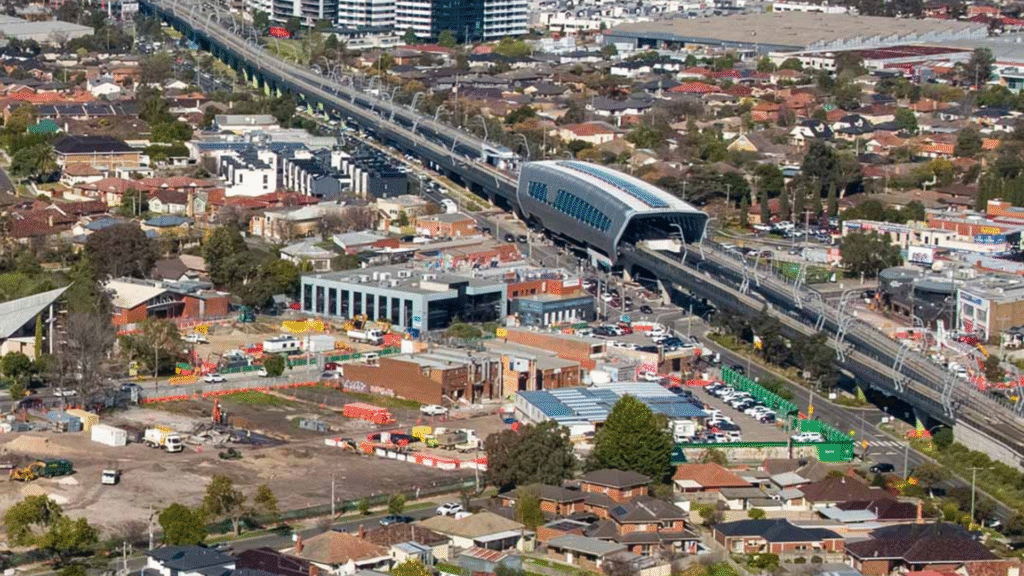
The Suburban Rail Loop (SRL) is a rapid transit system that is currently under construction in Melbourne. The 90km orbital rail line will run through Melbourne’s middle suburbs—from the Frankston line to the Werribee line via the airport. For investors, this indicates a massive growth in property value and rental demand over the next two decades.
Victoria’s transportation infrastructure is undergoing a massive transformation, marked by top projects including Metro Tunnel, North East Link, West Gate Tunnel, and most importantly—the Suburban Rail Loop and Airport Rail links.
With the estimated $2.2 billion investment, the Suburban Rail Loop (SRL) will link every major railway line from the Frankston line to the Werribee line via the airport. We can also say that the infrastructure will link employment, health, education, and retail facilities in Melbourne’s middle suburbs, making life easier for Victorians.
This highlights the potential growth of “Melbourne’s middle suburbs” in terms of transportation and lifestyle. For real estate investors, this means an increased demand for housing and other structures like hospitals, schools, and other facilities—particularly in Frankston and Werribee.
Given the importance of SLR, it’s worth taking time to understand the project. So, let’s begin:
Suburban Rail Loop (SRL): Quick Details
- Status: Under construction (SRL East)
- Locale: Melbourne, Victoria, Australia
- Website: www.websitesuburbanrailloop.vic.gov.au
- Stations: 6 (SRL East) | (SRL North) | (SRL Airport) | TBD (SRL West)
- Commenced: 2022 (SRL East, SRL Airport)
- Planned opening: 2035 (SRL East)
- Estimated cost: $31–58 billion
- Line length: 90 km
- Operating speed: 100 km/h (62 mph)
Difference Sections of the SLR Project
SRL East
The first stage of the project, SRL East, will connect Cheltenham to Box Hill with 26 kilometres of twin tunnels and new underground stations along the way.
Set to open by 2035, the new rail line will connect neighborhoods, including:
- Cheltenham
- Clayton
- Monash
- Glen Waverley
- Burwood
- Box Hill
SRL North
The new rail line between Box Hill to Melbourne Airport will generate jobs, diverse and affordable housing, and services like schools, playgrounds, and parks across Melbourne. Stops on line include:
- Doncaster, a middle suburb
- Heidelberg Station on the Hurstbridge line
- Reservoir station
- Bundoora
- Broadmeadows station
- The airport
SRL Airport
Extending from Melbourne Airport to Sunshine Station, the SRL Airport will be a part of the conventional rail network and run into the Melbourne CBD. It won’t be linked to SLR East and SRL North. Instead, Melbourne Airport Station and Sunshine Station will connect the line to other sections of SRL. Keilor East is also part of the project as an intermediate station.
SRL West
SRL West will run from Sunshine to Werribee. Combined with the Metro Tunnel and Sunbury Line Upgrade, the project will transform train travel for Victorians, making it quicker and easier to get to schools, work, and other destinations.
What does SRL mean for Real Estate Investors?
For investors, this represents a shift in where property value growth and rental demand may concentrate over the next two decades.
Long-term Capital Growth
Properties around SRL stations are expected to experience a hefty spike in value, thanks to better accessibility. Infrastructure development, convenience, and reduced commutes will make Melbourne’s middle suburbs attractive to residents and businesses. Renters are usually happy to pay a premium for convenience, while owner-occupiers highly appreciate usable public transport. So, being an investor, you can expect long-term capital growth.
Suburban Renewal
The Victorian Government has already assigned many SRL precincts to urban renewal and development. Box Hill, Clayton, and Glen Waverley are already experiencing rezoning and demand from developers. Long-term investors can profit from early entry to these markets.
Growth in Commercial Properties
As mentioned above, SRL will attract businesses outside the CBD. This represents a great opportunity for commercial property investors. Rising foot traffic and increased residential density around transit nodes usually boost the local economy. This will entice both tenants and investors in search of stable income.
Takeaway for Investors
The Suburban Rail Loop is more than a transport project — it’s a long-term catalyst for Melbourne’s suburban transformation. For real estate investors, it presents rare opportunities to position ahead of growth, particularly in suburbs set to become tomorrow’s urban centres.
Although it will take years to complete the full SRL, early-stage investors can benefit from lower prices and see their investments grow as the development progresses. It’s still important to pay attention to planning rules, construction schedules, and possible short-term disruption.