Investing in property in Australia has evolved beyond the traditional single dwelling model. Today, buyers are increasingly exploring smarter ways to maximize rental income, improve cash flow, and create long term flexibility. Two standout options are dual key homes and duplex properties. While they may appear similar at first glance, they operate very differently in terms of ownership, income potential, and exit strategy.
This guide breaks down the key differences, advantages, and drawbacks so you can decide which approach aligns best with your financial goals.
What Is a Dual Key Property?
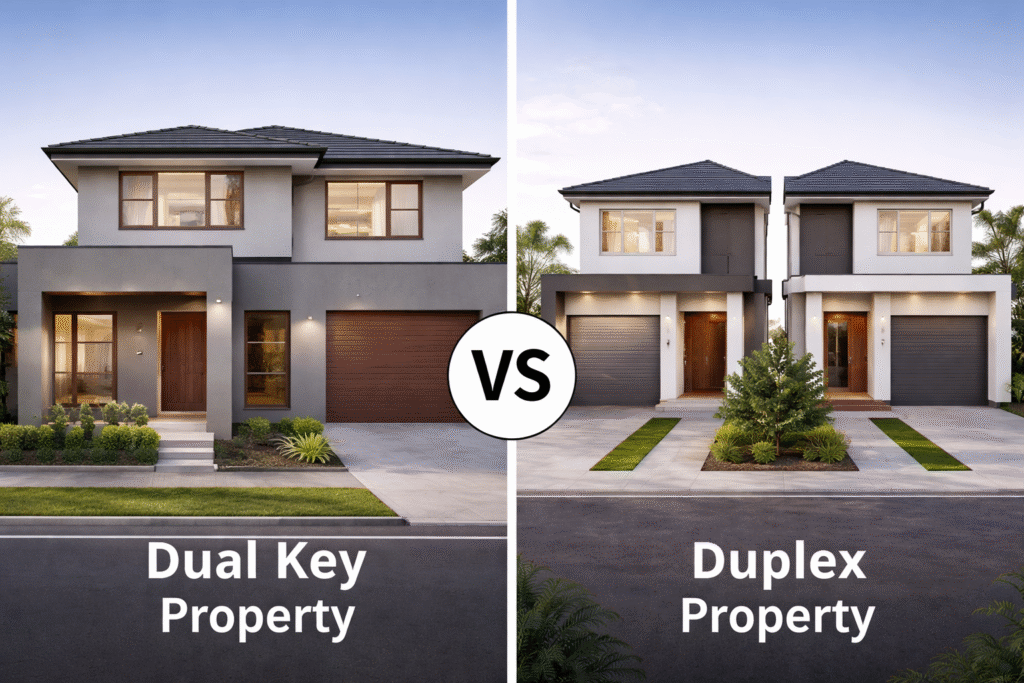
A dual key property is a single dwelling built under one title but designed to function as two separate living spaces. Typically, it includes a main residence and a smaller self contained unit, often sharing a common wall but with separate entrances.
Both sections can be rented out independently, but legally, they remain one property.
What Is a Duplex Property?
A duplex consists of two separate dwellings built on the same block. These can be attached or detached and are often designed with the option to subdivide into two individual titles.
This structure gives owners more flexibility in terms of selling, refinancing, or holding each dwelling independently.
Key Differences Between Dual Key vs Duplex Homes Australia
| Feature | Dual Key Property | Duplex Property |
|---|---|---|
| Title | Single title | One or two titles (if subdivided) |
| Entry Points | Separate entrances | Completely separate dwellings |
| Flexibility | Limited resale options | Can sell individually |
| Build Cost | Lower | Higher |
| Rental Income | Dual income streams | Dual income streams |
| Financing | Simpler but less flexible | More complex but flexible |
| Target Buyer | Entry level investors | Developers and experienced investors |
Dual Key Properties: Pros and Cons
| Pros | Cons |
|---|---|
| Lower purchase price makes it easier to enter the market | Cannot be subdivided or sold separately |
| Dual rental income improves cash flow | Limited capital growth compared to duplex |
| Single loan, insurance, and council rates simplify management | Lenders may undervalue dual income potential |
| Option to live in one and rent the other | Shared structure can reduce tenant privacy |
| Lower stamp duty due to single title | Fewer exit strategies when selling |
Duplex Properties: Pros and Cons
| Pros | Cons |
|---|---|
| Can be subdivided into two titles for separate sale | Higher upfront land and construction costs |
| Greater flexibility to sell, hold, or refinance | More complex council approvals and regulations |
| Higher resale value and buyer appeal | Longer development and build time |
| Attracts tenants seeking independent living | More complex financing structure |
| Stronger long term capital growth potential | Higher financial risk due to larger investment |
Which Option Is Better for Investors in Australia?
Choosing between a dual key property and a duplex depends largely on your experience level and investment strategy.
Dual key properties are ideal for investors who want a more affordable entry point and immediate rental returns without dealing with complex development processes. They are particularly suited to first time investors or those focused on steady cash flow.
Duplex properties are better suited for more experienced investors or those willing to take on a larger project. The ability to subdivide and sell separately creates opportunities for higher profits and long term flexibility.
Key Considerations Before You Decide
Choosing between a dual key and a duplex property is not just about cost or rental income. It requires a closer look at regulations, financing, market demand, and your long term strategy. Getting these factors right can be the difference between a high performing investment and one that underdelivers.
Click here to know the cost of dual key homes in Victoria in 2026.
Local Regulations and Zoning
Property rules vary significantly across Australia, especially between states like Victoria, New South Wales, and Queensland. Dual key homes are generally easier to approve because they fall under a single dwelling classification in many councils.
Duplex developments, however, often require specific zoning, minimum land sizes, and development approvals. Some councils encourage higher density housing, while others impose strict controls. Before committing, it is critical to check local planning schemes and speak with a town planner to avoid costly delays or rejections.
Financing and Lending Criteria
Financing plays a major role in determining feasibility. Dual key properties are typically treated as a single residential asset by lenders, which means simpler loan structures and faster approvals.
However, banks may not fully count both rental incomes when assessing borrowing capacity, which can limit how much you can leverage. Duplex properties, especially those involving construction, usually require more complex financing such as progress draw loans. The upside is that once subdivided, each dwelling can potentially be financed separately, giving you more flexibility to refinance or release equity.
Target Tenant Market
Understanding your rental audience is essential. Dual key properties often attract tenants such as extended families, couples seeking lower rent options, or individuals wanting semi-independent living. This can reduce vacancy risk because you are appealing to multiple segments.
Duplex properties, on the other hand, usually attract families or long-term tenants who prefer privacy and a full home environment. These tenants may be willing to pay higher rent, but expectations around quality and space are also higher. Matching your property type to local demand will directly influence rental stability and income.
Cash Flow vs Capital Growth
You need to be clear about your primary objective. Dual key properties are typically designed for strong cash flow. The dual income stream can help cover mortgage repayments and reduce holding costs, making them attractive in the short term.
Duplex properties often require more capital upfront but offer stronger long term capital growth due to land value and subdivision potential. If your goal is to build equity and create future resale opportunities, a duplex may align better with your strategy.
Risk Tolerance and Time Commitment
Dual key properties are generally lower risk and easier to manage, making them suitable for hands off investors. Duplex developments involve more moving parts such as design, approvals, construction, and higher financial exposure.
This means greater potential reward, but also greater risk if market conditions shift or costs increase. Be honest about how much time, effort, and risk you are willing to take on before deciding which path to pursue.
Final Thoughts
Both dual key and duplex properties offer unique advantages for property investors in Australia. Dual key homes provide a simpler, lower cost way to generate dual income, while duplex properties deliver greater flexibility and long term growth potential.
There is no one size fits all answer. The right choice depends on your budget, risk tolerance, and long term vision. Taking the time to align your strategy with your goals will put you in a much stronger position to succeed in the Australian property market.