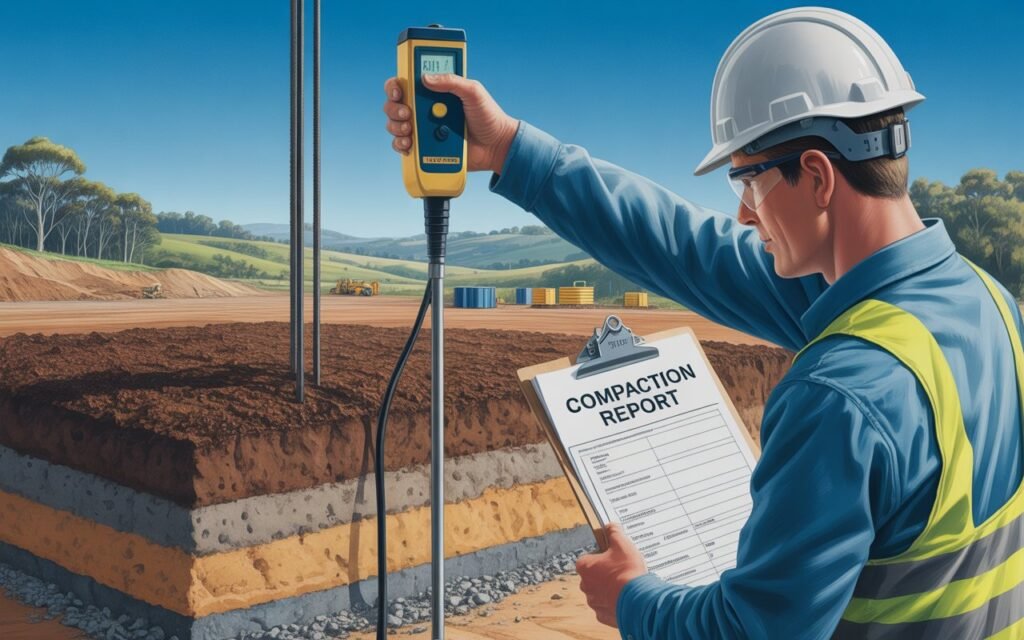
A compaction report is an official document testifying that the soil on a site has been adequately compacted. Prepared by geotechnical engineers, the report contains test results showing soil density, compaction quality, stability, and moisture levels. This report assures buyers, builders, and councils that the land is stable and suitable for future construction.
When buying land—developed or undeveloped—soil compaction testing is critical to determine the site quality and potential for development. Accordingly, you can make an informed decision whether or not to invest or initiate construction on the land.
That’s why a compaction report for land is critical in civil engineering. And, given that much of Australia’s land has clay soils, compaction testing becomes even more important for buyers in the country.
Let’s keep reading to know more about this crucial process:
What is soil compaction?
Soil compaction involves compressing the soil using mechanical force to make it denser and more stable. The process decreases or eliminates the air spaces between soil particles, shrinking and compacting them together.
As a result, the land becomes firmer and more capable of supporting the weight of structures. This is how soil compaction deters the land from shifting, moving, shrinking, or eroding over time—risks that cause cracks and uneven surfaces.
So, achieving soil compaction is the key to successful construction projects. A compaction report for a land testifies to this success.
What is Compaction Testing?
Compaction testing evaluates the percentage to which the soil of a land is compacted. The test helps civil engineers determine whether the compacted ground can support and maintain structural integrity without experiencing soil settlement, shrinkage, or other construction failures.
In Australia, almost all councils across Australia require compaction testing before a new build. In fact, it’s a standard step in site preparation and must be done according to Australian Standards such as AS 1289.
How Compaction Testing Works?
In compaction testing, soil samples are tested in laboratories to determine how tightly the soil particles are packed and their moisture content.
The entire testing process typically takes place in three steps:
Step 1: Sample Preparation
Soil samples are tested in a lab where the sample’s properties are monitored to replicate field conditions.
Step 2: Compaction Process
The soil sample is compacted using a compaction mold, a mechanical rammer, or a vibrating hammer. The compaction is done in layers to stimulate the actual field conditions.
Step 3: Density Measurement
Once compacted, the density of the sample is measured by factoring in the moisture content. Finally, the results are compared against the project’s specifications to ensure that the required level of compaction has been achieved.
Field Compaction Testing Methods
Field compaction tests provide real-time data, enabling adjustments to ensure the structural integrity of the build. The most common methods are:
Sand Cone Test: A small hole is excavated in the compacted soil and filled with calibrated sand from a cone apparatus. The volume of sand required to fill the hole is measured. This measurement, combined with the weight of the excavated soil, helps calculate the in-place density of the compacted soil.
Nuclear Density Test: This is the most common compaction testing method used in Australia. A nuclear gauge is used to measure the in-place moisture and density of the soil. The gauge emits gamma radiation into the soil and measures the reflected energy, which correlates with the soil’s density and moisture content.
Drive Cylinder Method: A metal cylinder is driven into the compacted soil to extract a sample. The sample is weighed, and its volume is determined to calculate the soil’s density. This method is particularly useful for granular soils, such as sand and gravel, where other testing methods may be less effective.
Once done, the results are compared with required compaction standards (for example, “95% of maximum dry density”). If the criteria are met, the soil is approved. Otherwise, it may need reworking or additional compaction.
The final results are documented in the compaction report, providing confidence to councils, builders, and investors that the site has a solid foundation for development.
Final Words
To conduct soil compaction testing in Australia, you should find a specialized, NATA-accredited soil testing company. The company will visit the site, take samples, conduct lab and field tests, and create a comprehensive compaction report for the land. This report is a critical deciding factor in whether your land is stable and suitable for development.
Join the community of Property Buyers Australia to get the right guidance for soil compaction testing. You can also connect with licensed experts—mortgage brokers, conveyancers, and real estate agents—to get support for property investment in Australia.